
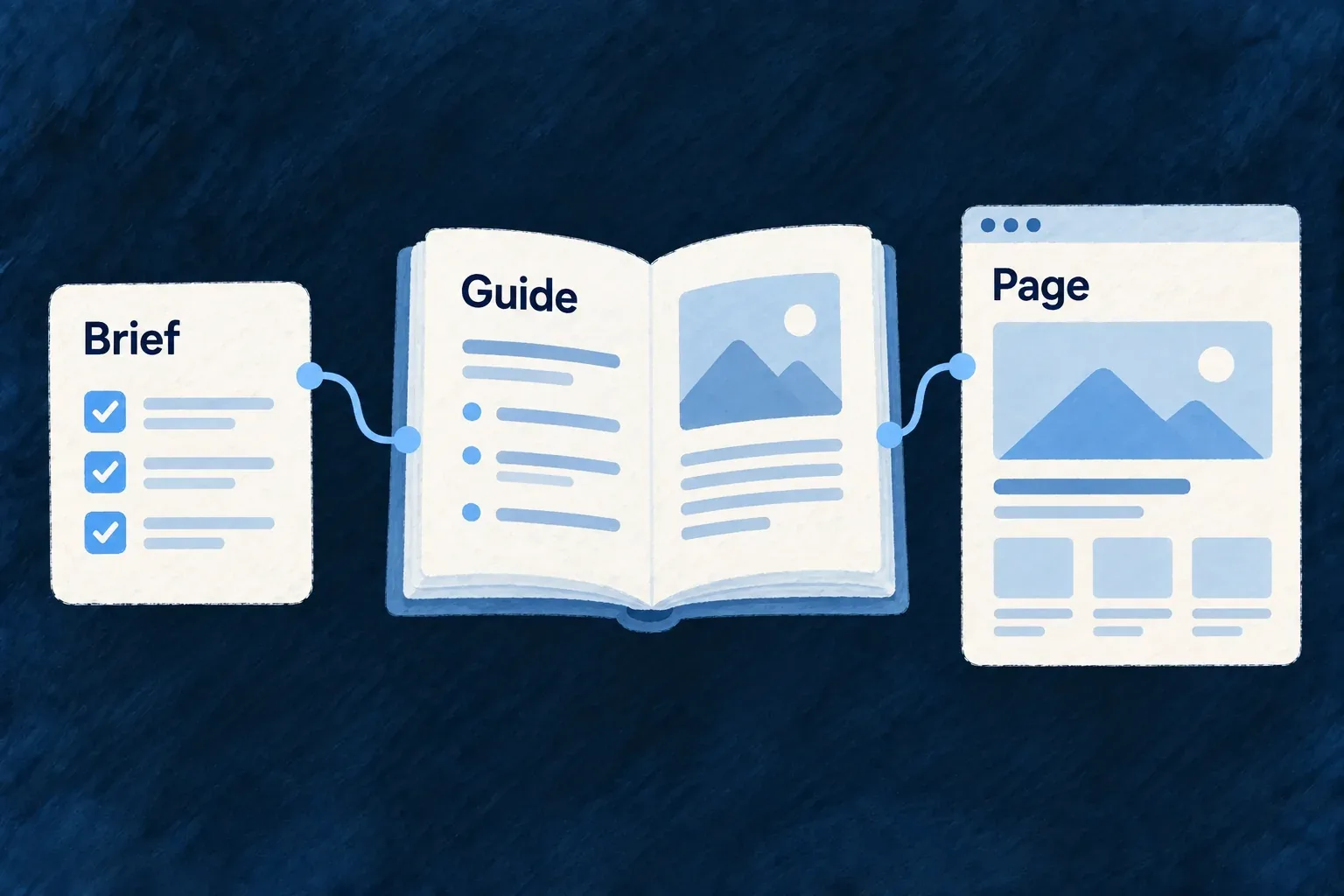
Give your coding agent a website authoring guide
Application-facing guides teach the coding agent how to add pages, sections, navigation and discovery metadata using Wildo’s actual website contracts. They give implementation work a consistent starting point while leaving the product story and design to you.
Example — A pricing page that belongs to the product
The agent reads the pricing-section guide, checks the application’s actual offers, and registers the page and its language keys. It does not invent a new pricing model from a generic landing-page template.
For engineers
The framework knowledge catalogue routes website tasks to section-specific guides and cross-cutting guides for pages, labels, discovery and bundle discipline. Use the installed knowledge for the application’s accepted framework version, then inspect the application’s existing site.
| Work | Authoring owner | Check before accepting |
|---|---|---|
| Add a section | Section definition and component | Category, expected keys, component props |
| Publish a page | Page manifest, root registry and Astro route | Direct route, locale routes, metadata |
| Change wording | Language packs | Expected-key coverage and actual rendering |
| Add interaction | Browser island and supported public imports | Hydration, failure feedback, bundle boundary |
A useful registration checkpoint is the page’s actual join, as demonstrated by Wonder Todos:
export const LANDING_PAGE_MANIFEST = defineWebsitePageManifest({
  ref: 'landing',
  routePath: '/',
  pageComponent: LandingPage,
  sectionRefs: [
    LANDING_HERO_SECTION.sectionRef,
    LANDING_FEATURES_SUMMARY_SECTION.sectionRef,
    LANDING_SOCIAL_PROOF_SECTION.sectionRef,
    LANDING_FINAL_CTA_SECTION.sectionRef,
  ],
  metaLabelKeys: {
    titleKey: WebsiteLabelKeySchema.parse('website.landing.meta.title'),
    descriptionKey: WebsiteLabelKeySchema.parse('website.landing.meta.description'),
  },
});
These are application-owned declarations; the guide is not a second runtime registry. Keep facts such as price, audience and product promises grounded in application sources, and verify the rendered page. Having the guide installed does not prove that an agent followed it or that its output is ready to publish.