
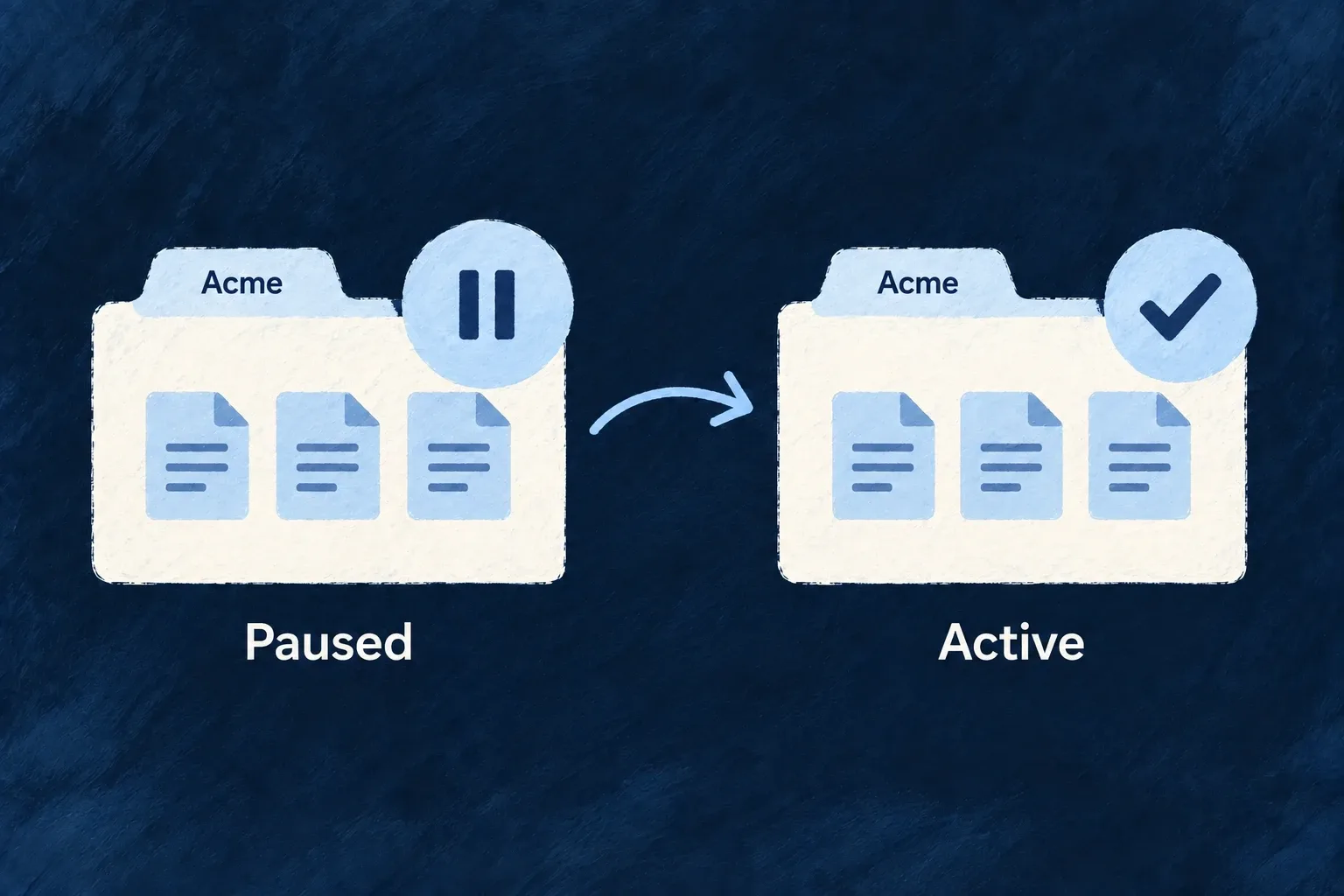
Pause a workspace without deleting it
Suspension stops a workspace from conferring authority while preserving its data. It gives the operator a way to halt activity while an account or security problem is resolved.
Reactivation returns an eligible suspended or expired-trial organisation to active operation. Recovery has its own authorised path because the suspended organisation’s members cannot lift the suspension themselves.
Example — Pause an account while a problem is investigated
An operator suspends a customer workspace with an explanation. Its records stay in place; when the matter is resolved, an authorised reactivation makes the workspace active again.
For engineers
Use a lifecycle action rather than a status patch
An illustrative suspension request body is:
{
  "suspensionReason": "Account activity is under review",
  "notifyMembers": false
}
Submit it through organizations.suspend with the required platform authority and tenant reach. The action accepts ACTIVE or TRIAL; it refuses an already suspended organisation. The reason is required, and notifyMembers: false suppresses its member notification.
Understand what the transition changes
The transactional implementation sets the organisation to SUSPENDED, reconciles application user types granted by that organisation type and tied to membership through requiresOrgMembership.orgTypes. The paired organization/user-type declarations are prerequisites for that revocation: the organization type names what it grants, and the user type names the organization types whose membership it requires. Another qualifying active membership preserves the type. Without that membership requirement, this reconciliation does not remove the application user type; the suspended workspace still stops conferring organization-scoped authority. Tokens are invalidated when a type is actually revoked, rather than logging out every member unconditionally. Organisation-scoped authority is derived from the current organisation state, so retained membership rows do not keep conferring access.
Reactivation sets ACTIVE; it does not restore a remembered previous trial state. The activate operation accepts SUSPENDED or TRIAL_EXPIRED and re-grants organisation-derived user types.
Give recovery its own reach
Activation explicitly admits the platform cross-tenant administration path. A non-member platform operator still needs the applicable time-limited access grant for the target organisation. Suspension does not acquire that crossing merely because activation has it.
Both actions enforce their state conditions on the server as well as in the interface. Follow reversible deletion when the intended outcome is offboarding rather than a temporary pause.