
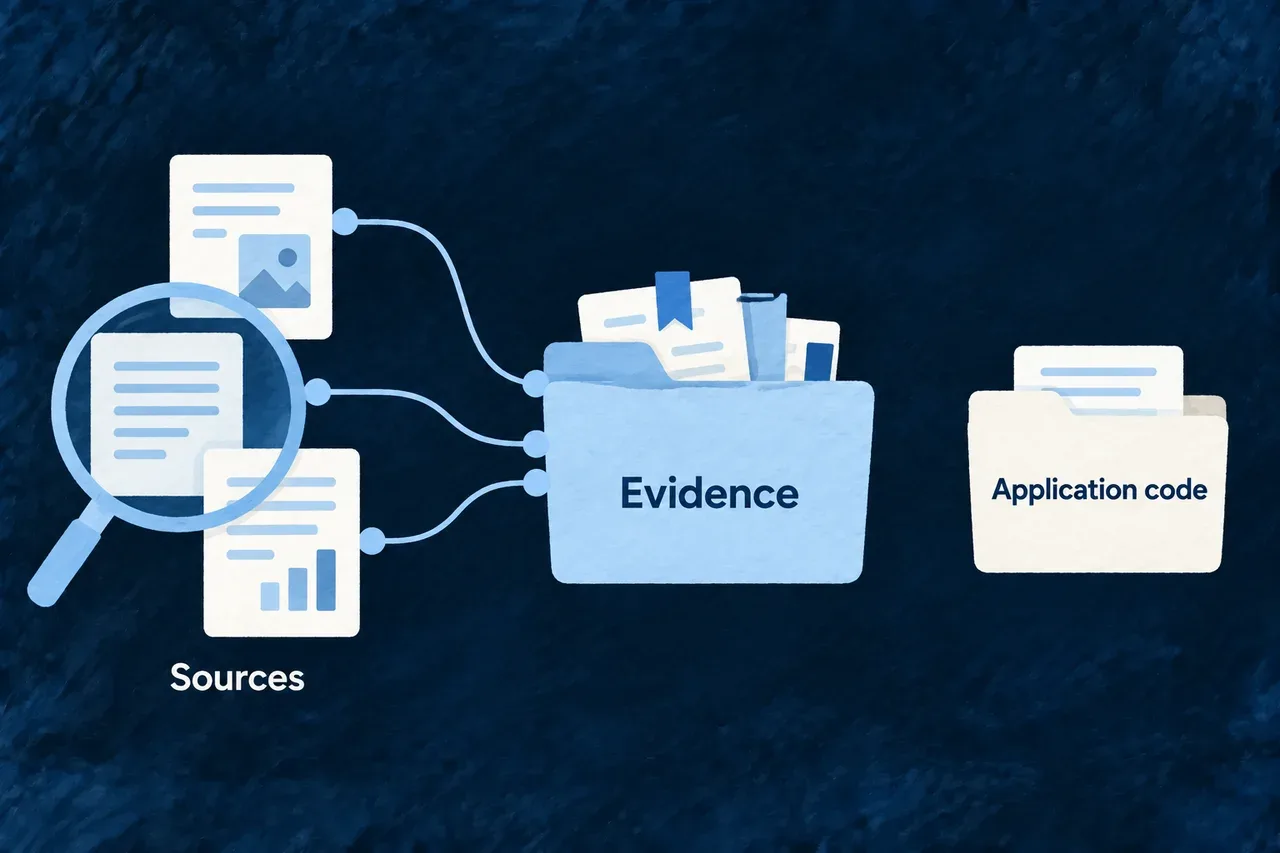
Research a question and keep the evidence
Some product decisions need information from outside the project: market evidence, published requirements or a provider’s documented behavior. Wildo separates that investigation from the agent work that changes application code.
The research lane gathers findings into a dedicated evidence store, where later rounds can build on earlier sources. A returned answer remains material to assess; it does not become an accepted product fact simply because an agent wrote it.
Example — Compare published plans before choosing a provider
A researcher gathers the relevant pricing pages, records the source beside each finding and notes what remains unclear. A later round can extend that record rather than repeating the investigation from the beginning.
For engineers
Configure the research posture separately
The research agent uses its own execution profile. These selected settings appear in the Wonder CRM research profile; the complete configuration also supplies the provider launch details and model destinations:
permissionCeiling: AgentClientProtocol_PermissionCeiling.AUTO_ACCEPT_READS_AND_EDITS,
hostConfigurationInheritance:
  AgentClientProtocol_HostConfigurationInheritance.ISOLATED,
turnTimeoutMs: 15 * 60_000,
maximumRecordedEventBytes: 2 * 1024 * 1024,
The permission ceiling admits recognized reading, searching, fetching and thinking tools, plus edits. It excludes command execution and unclassified tool kinds. The host restricts declared filesystem access to specifications/research-evidence/. It applies the same evidence boundary to direct client reads and writes, including callbacks sent without a permission request. A refused read is recorded as a scope denial; research can persist findings without receiving general workspace access.
These controls depend on the adapter exposing the relevant permission requests or client filesystem operations. Wildo’s provider compatibility checks and execution profile matter here as they do for coding. An isolated host configuration controls inherited agent guidance; it does not mean an offline run or a local model.
Keep findings across research rounds
Each request has an objective and can name an evidenceScope for the investigation. The companion resolves the scope to a directory and adds the same evidence-store instructions to each round:
specifications/
  research-evidence/
    provider-selection/
      published-plans.md
      usage-conditions.md
This is an illustrative directory layout. The agent is instructed to read existing findings first, write coherent topic files as it works and keep source URLs beside findings. The store sits outside the specification TypeScript source tree, so a research note does not become a typed product declaration.
At the end of a non-cancelled run, the companion also attempts to save the final brief with its objective, timestamp, elapsed time, stop reason and optional playbook reference. A failed backstop write is logged and can leave persistedEvidencePath empty; callers should inspect that field before reporting that a durable record exists.
Interpret research results before accepting them
| Result information | How to use it |
|---|---|
| Evidence prose | Review source relevance, attribution and unanswered questions |
| Stop reason | Distinguish a completed response from an interrupted or unusual ending |
| Permission decisions | See whether denied tools explain a thin answer |
| Persisted evidence path | Locate the companion’s saved final brief when persistence succeeded |
| Reported file locations | Understand the agent’s account of its activity, without treating it as an independent filesystem audit |
A cancelled final response is not saved as a completed brief. Files already written during the run remain available for inspection. Research can run alongside coding; the coding change-set logic records research-store changes as a concurrent host lane and excludes them from the coding task’s mutation-scope decision.
Choose which findings enter the product definition through the appropriate review and validation process. Neither a source URL nor successful persistence establishes the truth of a claim. The turn timeout stops a runaway turn; it is not a token or monetary budget.