
Ground an agent’s change in the existing application
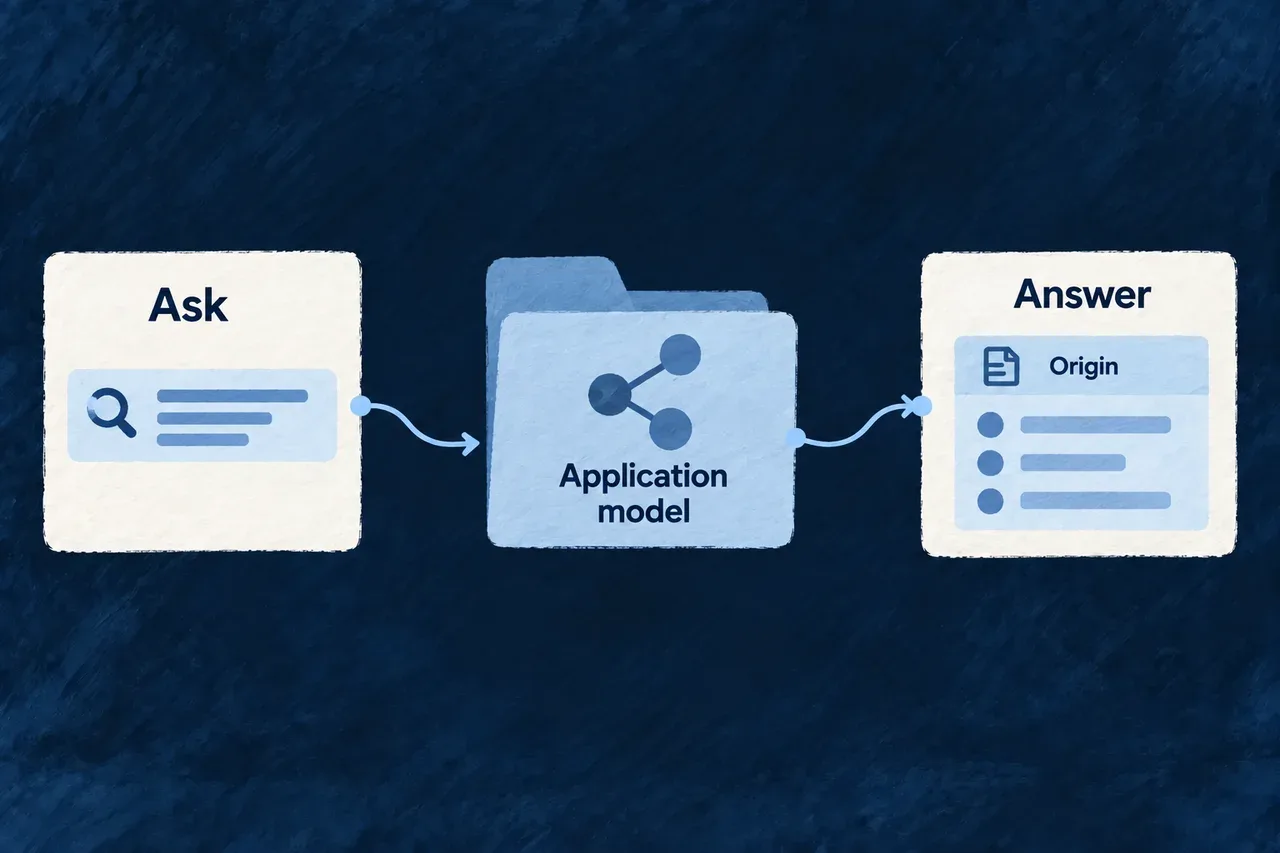
A coding agent can ask the running companion about this application’s declared resources and specifications before choosing what to edit. That gives it application-specific contracts alongside the framework guidance it already reads.
The useful result is a better-grounded change: reuse an existing name, extend the operation already declared, and check the relationships the change must respect.
Example — Extend an existing action instead of creating a second one
A team asks an agent to add approval behavior. If the returned resource model already declares an approval action, the agent can inspect that action’s specification and implementation before deciding to extend it. If the action is absent from the selected model, it investigates the source and service context before introducing a new contract.
For engineers
Query from the application workspace
The following inspection sequence assumes that this application’s companion is running. These behavior identifiers exist in the companion catalogue; the live menu remains the source for service keys and available views:
# Check that this application's companion answers.
wildo context health

# Discover behaviors and their available service keys.
wildo context list

# Inspect resolved resources and their specifications.
wildo context info resources-registry

# Read the declared contracts alongside the registry.
wildo context info resource-specifications

# Inspect the exposed specification artifacts.
wildo context info specification-artifacts

# Read creation state and cross-family coherence.
wildo context journey
wildo context coherence
The sequence is a set of read-only questions, not a generation or acceptance workflow. Its results help select the next action; they do not execute that action.
Turn retrieved context into an editing decision
The following is an illustrative reasoning record, not a captured response or an automatic decision made by the companion:
| Information returned | What the agent should establish next | Effect on the change |
|---|---|---|
| The resource already declares an approval action | Read its specification and locate its implementation | Extend that contract rather than create a competing action |
| A relationship connects the record to an owning project | Inspect how the action receives and checks that context | Keep the change consistent with the declared ownership |
| The requested resource is absent from the queried model | Check the selected service, source registration and emitted output | Resolve the discrepancy before assuming the feature is missing |
The companion supplies context; the agent makes the coding decision. Carry the relevant returned names, contracts and provenance into the editing task. Compare them with source files rather than treating either a partial file search or one model response as the entire application.
For selecting a service, supplying behavior input and reading the output format, follow terminal inspection. For creation-state and cross-family checks, use the dedicated journey and coherence queries described in the application context workflow.
Preserve the provenance when using an answer
The human/tool output includes a provenance line followed by a formatted payload. It is not a pure JSON stdout contract to feed blindly into a JSON parser.
For compiled-model queries, the CLI explains that unemitted source edits are absent. A response reporting servedFromCache: true establishes reuse of a held derivation; missing reuse information does not establish that a fresh subprocess ran. Journey and coherence answers have different source semantics, so keep the provenance attached when passing information into a coding task.
Read-only does not mean every HTTP request is GET
The introspection call used by context info is a read-only POST. The CLI supplies the machine-local token that the custom companion router requires for that request. This access contract is separate from production API permissions or human approval of a code change.
The wider context command family also contains other tools, including assurance-related commands. The companion-backed sequence above is not an exhaustive claim about every subcommand or about all of them requiring a running companion.
Turn the answer into a checked change
Use the returned names and contracts to ground the edit, then compile and test the relevant application behavior. Re-querying a registry can show that the expected declaration is exposed; it cannot show that the full operation works for a particular user’s role and data.