
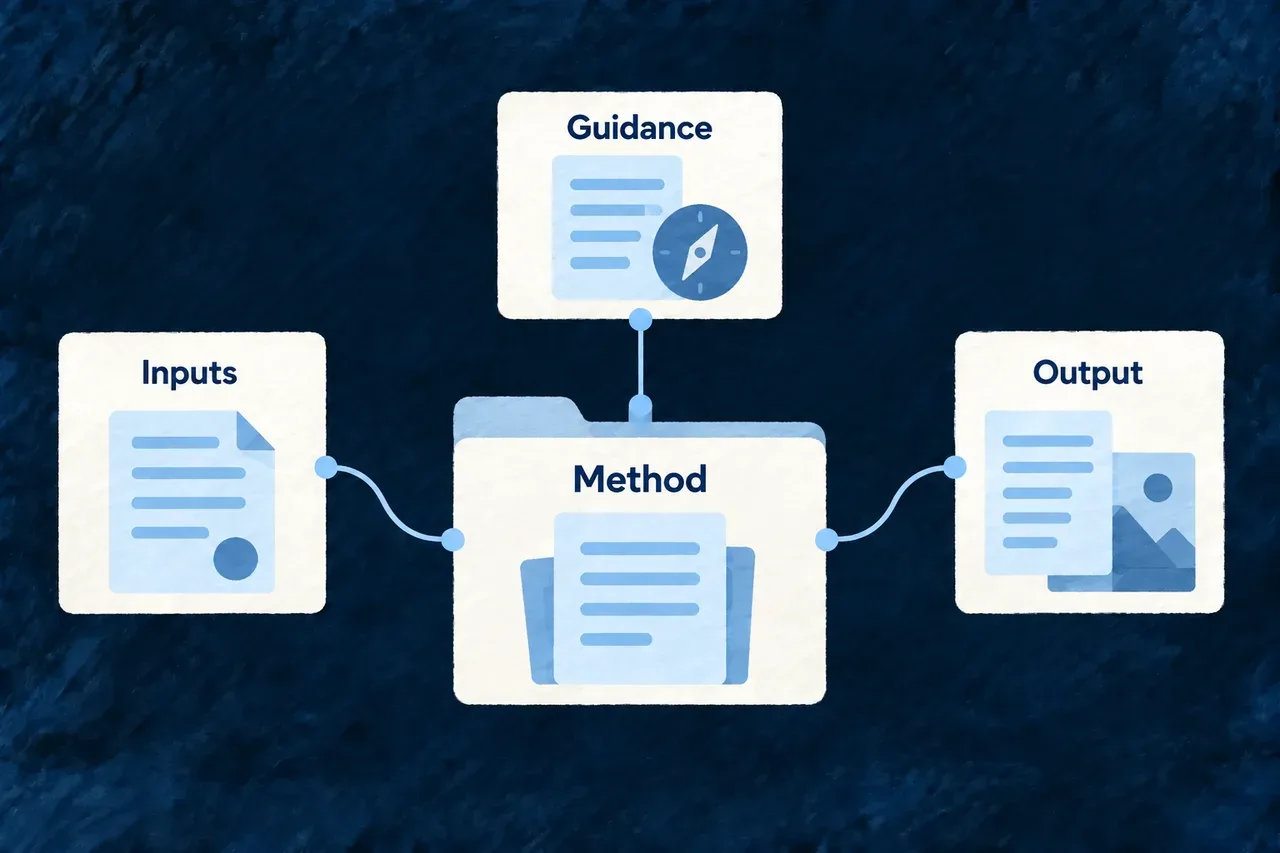
Give recurring work a reusable method
A playbook gives a recurring piece of product work a clear purpose and a method. It declares the information it needs, the guidance to use and the result to produce.
Wildo brings those declarations together in a catalog. Teams and agents can revisit research, planning or implementation as the application changes, while keeping the same explicit expectations for the work.
Example — Revisit requirements with the right starting point
After customer research changes, the requirements method reads the vision and market information together. Its output remains a requirements snapshot, so later planning can continue from the updated product definition.
For engineers
Declare inputs and outputs separately
This selected excerpt comes from the requirements playbook definition. Imports and the remaining definition are omitted:
preconditions: [
  { kind: MetaWorkflow_PredicateKind.ARTIFACT_VALID, selector: { family: 'vision-brief' } },
  { kind: MetaWorkflow_PredicateKind.ARTIFACT_VALID, selector: { family: 'market-snapshot' } },
],
inputs: [
  { family: 'vision-brief' },
  { family: 'market-snapshot', intent: MetaWorkflow_ArtifactIntent.VALUE },
],
outputs: [{
  family: 'requirements',
  schemaRef: 'saas-specifications:RequirementsSnapshot',
}],
method: {
  skillRefs: ['journey-status', 'journey-report'],
},
The excerpt omits the output’s descriptive metadata for clarity. A precondition asks whether the work may start; an input selects information for that work; an output names the artifact contract. A skill supplies instructions. These declarations answer different questions even when they refer to the same family.
Author the method where it belongs
Each catalog folder holds playbook.definition.ts beside method.md. The generator evaluates supported declarative syntax without executing the definition, expands method references and validates the compiled playbook. method.guidance comes from the Markdown rather than a second inline copy.
| Declaration | Meaning for execution |
|---|---|
phase | Organizes the catalog; it does not assign one current phase to the whole application |
preconditions | Supplies explicit readiness and sequencing checks |
inputs and contextSources | Selects artifact information and computed context |
outputs or stepOutputs | Distinguishes persisted artifacts from values returned within a run |
executor | Selects the execution lane |
method.choreography | Composes admitted child methods |
Review the connected result
A valid definition establishes a method contract. The method still needs useful instructions, appropriate skills and an executor capable of producing its declared result. Review those together when adding a playbook; a phase label alone establishes no dependency order.
The connected requirements example follows this registered method through its HTTP invocation, response and specification files.