
Give each process one consistent environment
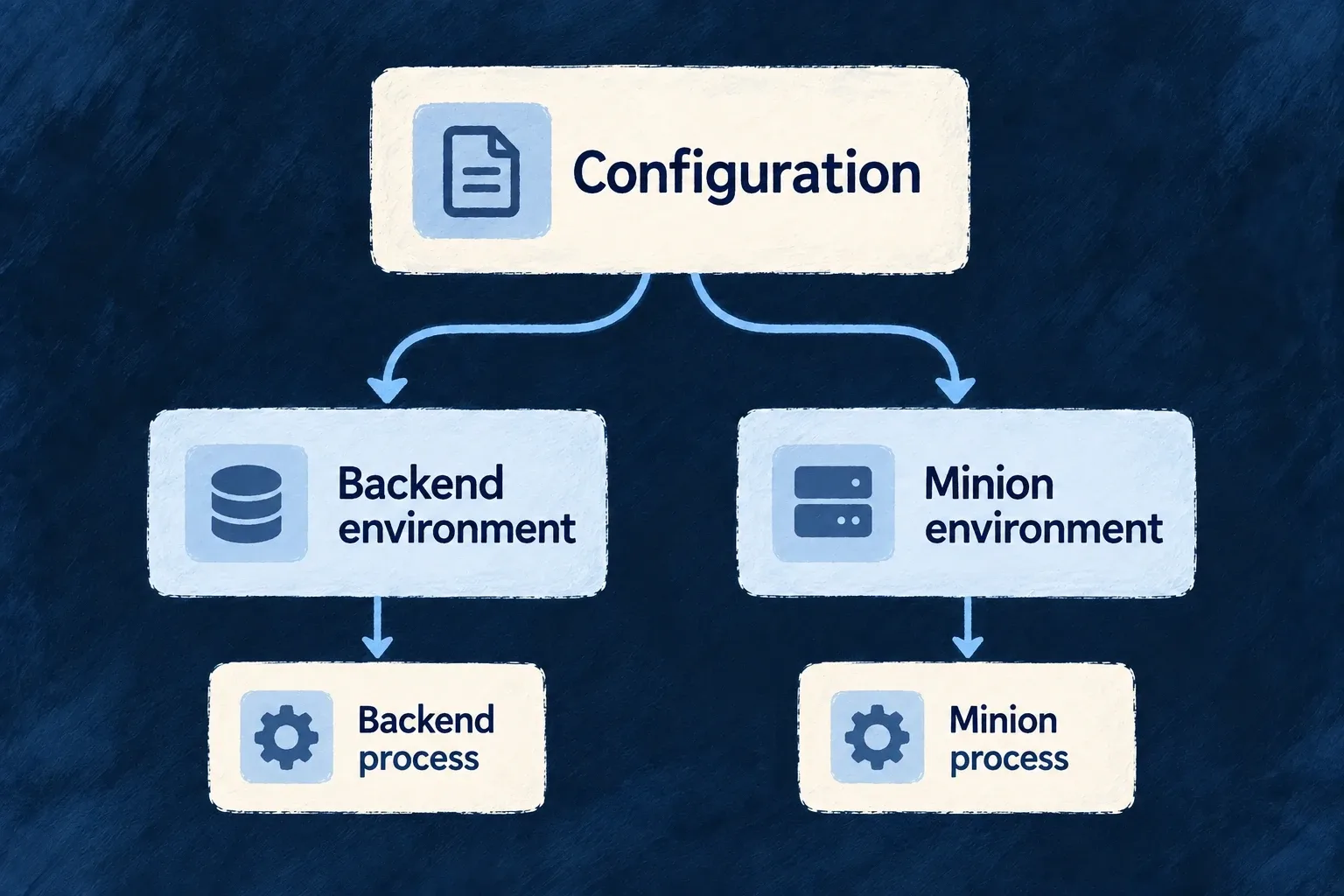
Wildo turns authored configuration and scoped secrets into the environment each process reads. A backend, frontend or background runtime receives its own generated projection, so configuration does not depend on hand-maintained copies of the same value.
Example — Give each process one consistent environment
A multiline verification key is authored once and encoded for the environment reader used by its service. The generated runtime receives the complete key rather than a truncated first line.
For engineers
Author application and infrastructure choices in their configuration files. Use configuration synchronization to regenerate derived environments; edit the source value instead of patching a generated .env.
Builders return raw values. The local dotenv writer encodes them exactly once for its reader:
Selected source from env-configuration-generator.service.ts:
function writeEnvFile(filePath: string, env: Record<string, string>): void {
  const dir = dirname(filePath);
  if (!existsSync(dir)) {
    mkdirSync(dir, { recursive: true });
  }

  const content = Object.entries(env)
    .map(([key, value]) => `${key}=${encodeDotenvValue(key, value)}`)
    .join('\n');

  writeFileSync(filePath, GENERATED_FILE_HEADER + '\n\n' + content + '\n');
}
For example, take this harmless raw value (two lines, not a real key):
PUBLIC-LINE-ONE
PUBLIC-LINE-TWO
The Node dotenv sink writes one quoted entry with an escaped newline:
EXAMPLE_PUBLIC_MATERIAL="PUBLIC-LINE-ONE\nPUBLIC-LINE-TWO"
The dotenv reader reconstructs PUBLIC-LINE-ONE followed by a newline and PUBLIC-LINE-TWO. The provider passes the original two-line value; it does not add the quotes or the escape sequence itself.
Compose and Kubernetes have their own sink encoders. A value safe for one format is not necessarily correctly escaped for another. This is why providers and runtime builders should supply the raw key or JSON value, not a pre-quoted string.
Keep runtime projections separate
The generator creates environments per process kind. Kubernetes runtime environment Secrets and provider credential Secrets have derived names shared with the workload manifests. A runtime without provider contributions does not need a provider-secret mount; it still needs its required runtime environment.
| Consumer | Generated input | When a change takes effect |
|---|---|---|
| Node backend or declared background process | Its own .env | Restart with the regenerated environment |
| Frontend | Its generated .env and companion .env.example | Restart its development process or produce the new frontend deployment |
| Kubernetes workload | Required runtime environment Secret and applicable provider Secret | Apply artifacts and roll out the consuming pods |
Generation changes an artifact, not the memory of an already-running process. Restart or roll out the affected runtime so it reads the new projection. Protect local environment files and deployment artifacts as secrets-bearing material; encoding a Kubernetes Secret is not an at-rest encryption policy.