
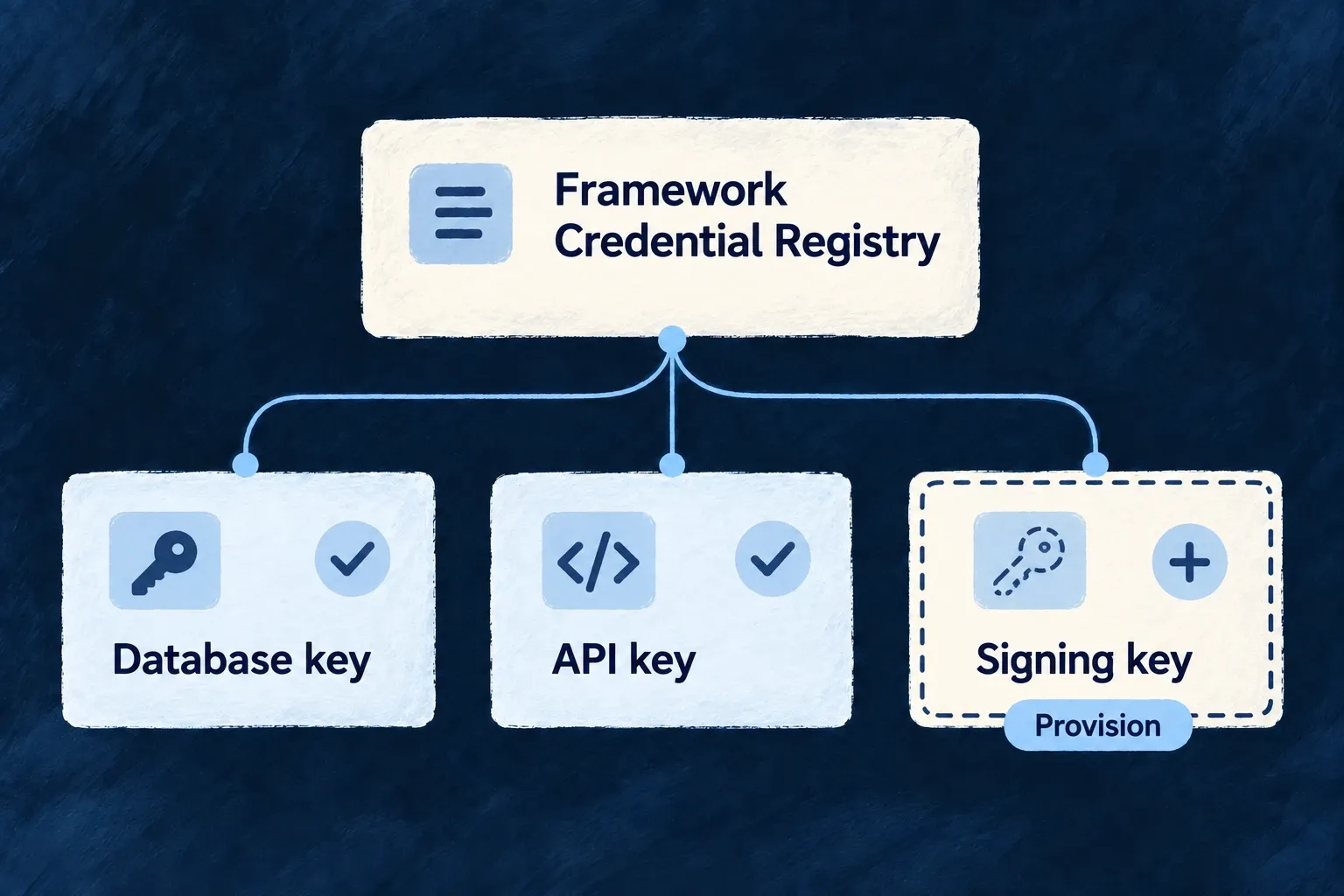
Fill missing framework credentials without replacing working ones
Wildo declares the credential material it manages in one registry. Configuration synchronization can provision missing material while keeping already-provisioned credentials, so an existing environment can acquire what a new framework capability needs.
Example — Provision missing secrets without replacing working ones
An environment gains a new signing-key material during synchronization. The keys already used by its running services remain in place; deliberate rotation follows a separate action.
For engineers
wildo config sync invokes provisioning for file-backed environments. Each registry material declares its identity keys, generated secret keys, purpose, presence check and provisioning/rotation functions.
The provisioning loop checks each material before and after minting:
Selected source from framework-managed-secrets.ts:
export function provisionFrameworkManagedSecrets(
  secrets: PlatformEnvSecretsDraft,
): FrameworkManagedSecretsProvisioningResult {
  const mintedRefs: FrameworkManagedSecretMaterialRef[] = [];
  const mintedKeys: string[] = [];

  for (const material of FRAMEWORK_MANAGED_SECRET_MATERIALS) {
    if (material.isProvisioned(secrets)) continue;

    material.provision(secrets);

    if (!material.isProvisioned(secrets)) {
      throw new Error(
        `Framework-managed secret material '${material.ref}' did not satisfy its own provisioning check. `
        + 'This is a registry authoring bug in framework-managed-secrets.ts, not an environment problem.',
      );
    }

    mintedRefs.push(material.ref);
    mintedKeys.push(...material.identityKeys, ...material.secretKeys);
  }

  return { secrets: secrets as PlatformEnvSecretsJson, mintedRefs, mintedKeys };
}
The selected source returns the updated structured secrets object together with the material and key names it created. Operational reporting can use those names without displaying credential values. A material that fails its own presence check aborts provisioning instead of saving a falsely complete environment.
Keep backfill distinct from rotation
Normal synchronization provisions missing materials; --rotate-secrets is the explicit rotation choice. The general overwrite flag does not imply rotation. Rotation must be coordinated with the deployed services and published verification keys that use the changed material.
The registry groups keys that belong together. A complete existing material is preserved; repairing a partially missing material follows that material’s own provisioning function. Do not remove one key from a running credential pair as a way to request routine synchronization.
Keep operator choices with the operator
The registry can generate an administrator password when one was not supplied, but it does not invent the administrator’s identity. Vendor credentials and other operator-authored values remain inputs. In a fileless CI lane, the framework reads persisted secret-store material rather than minting new credentials that disappear with the runner.