
Deliver guidance with the framework it describes
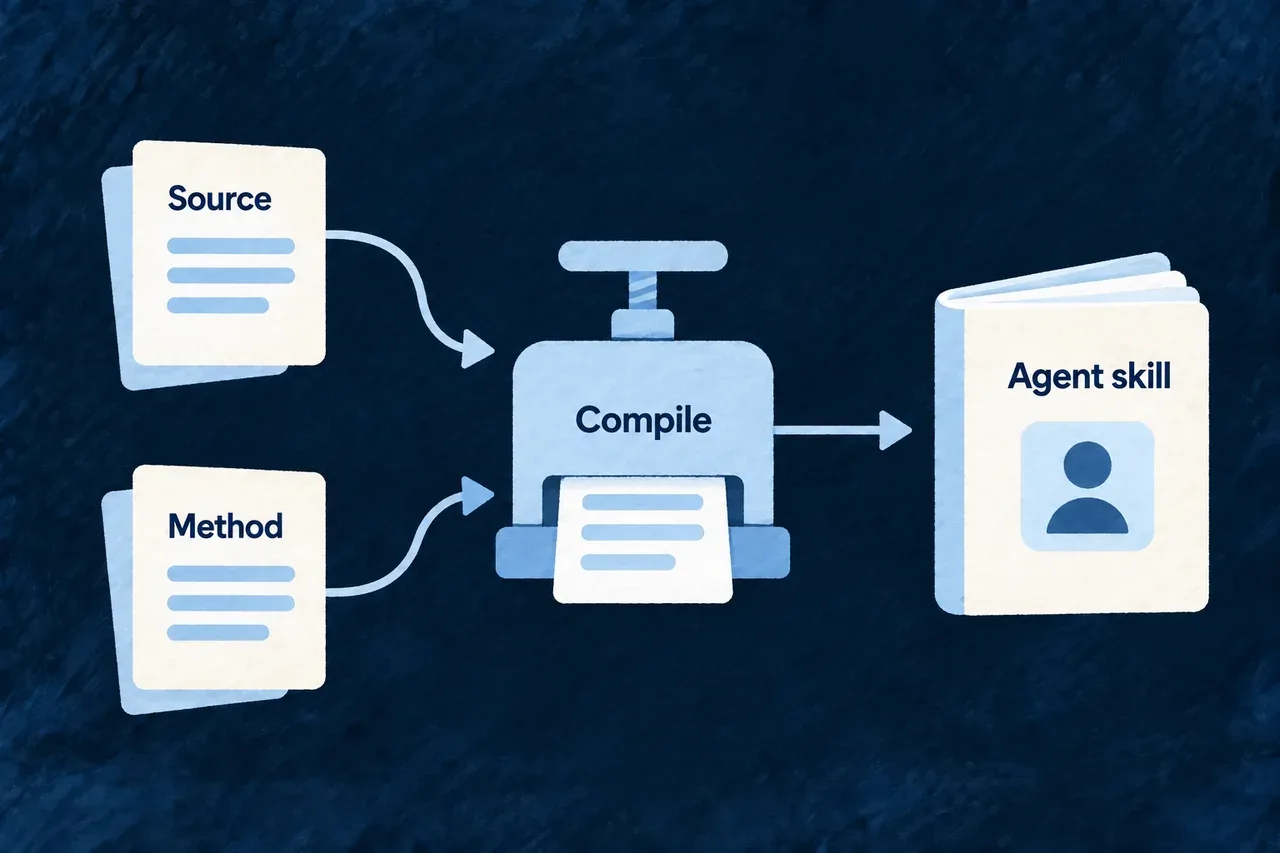
An agent needs both the supported contracts and a method for using them. Wildo brings those inputs together in a generated knowledge package.
Shared explanations, source excerpts, guides and rules are assembled for delivery. The application receives a coherent set of references for the framework version it uses.
Example — Update a module contract and its teaching
A framework maintainer changes a module extension point, updates the explanation and regenerates the guidance. An application updating that package can then refresh the corresponding guides instead of retaining a separately copied API example.
For engineers
Follow the inputs to their consumers
| Input | Compiled role |
|---|---|
| Authored skill workflow | Explains decisions and the sequence of work |
| Shared partial | Reuses an explanation across relevant guides |
| Registered source topic | Supplies extracted contract code in a reference |
| Rules and playbooks | Supply standing guidance and structured methods |
| Manifest and topic index | Describe the generated payload and its reference subjects |
Compilation expands references and reusable prose. Payload validation checks supported structural and application-guidance constraints before publication. These checks detect specific problems; they do not establish the semantic truth of every sentence.
Refresh the right side of the boundary
For framework maintainers, from the framework workspace:
# Check the source-to-guidance connections.
wildo fwk audit

# Generate the knowledge payload from the current authored inputs.
wildo fwk generate-docs

# Development delivery to an explicit application (replace this path).
wildo fwk dev-skills --target /absolute/path/to/application
For an application builder, the normal delivery command is wildo assets sync, using the installed knowledge package. The development-target command above serves framework maintenance; it is not a prerequisite for ordinary application work.
Publish validated output
The generator writes into staging, assembles its manifest and registries, then validates the staged payload before publishing it. A failed staged validation stops that publication. The separate integrity audit checks additional source relationships, including malformed anchor ranges.
After publication, installation still has to deliver the files to the application, and the agent host still has to load them. Keep those steps explicit when diagnosing an old reference: inspect the generated payload, the installed package and the delivered file rather than assuming a source edit reached all three.