
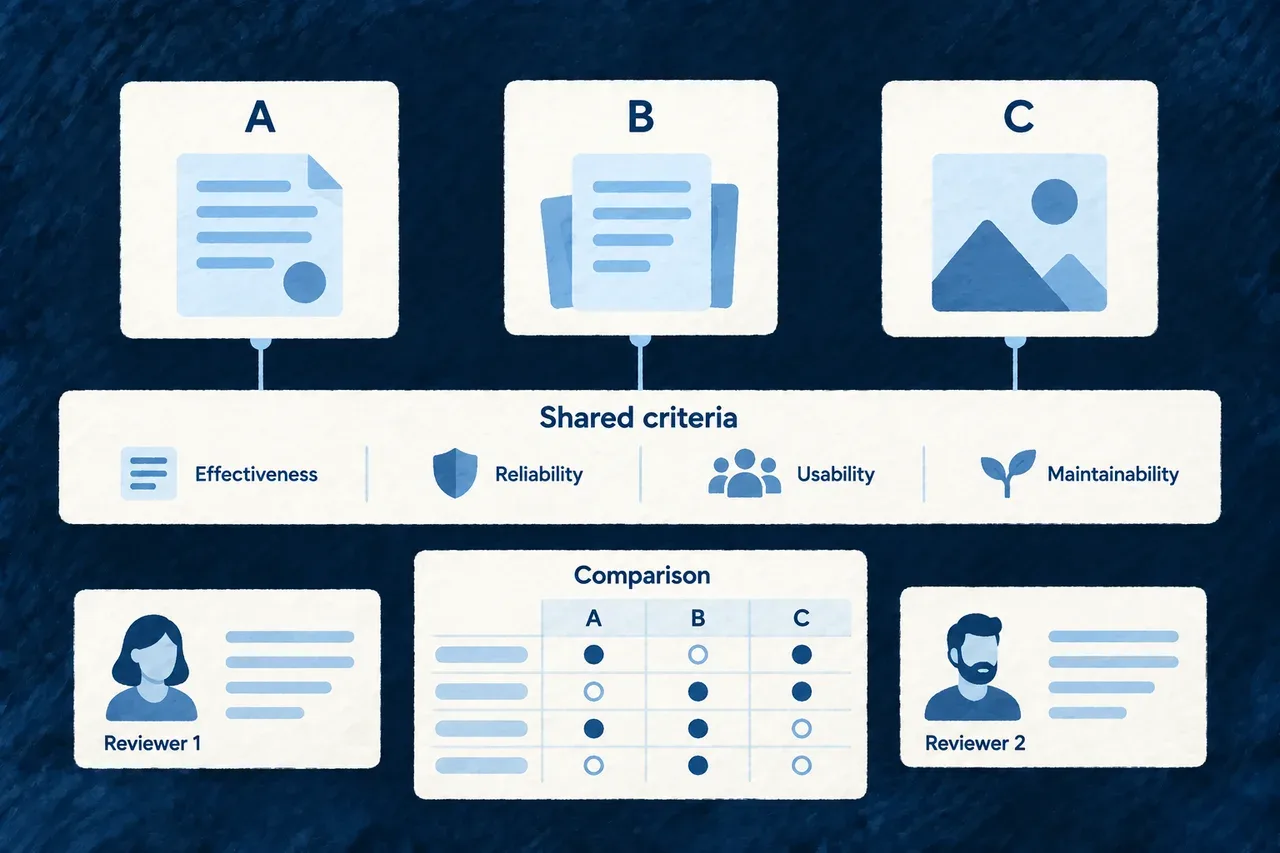
Compare alternatives through several expert lenses
Some decisions have several reasonable answers. Wildo can produce alternatives, evaluate them through selected expert perspectives and retain the reasoning behind the chosen direction.
A shared rubric keeps the comparison consistent across review rounds. The panel can request focused revisions, making the discussion about what should improve rather than which answer appeared first.
Example — Compare two ways to organize a workspace
One proposal groups screens around teams; another groups them around the work being done. An information architect examines the navigation model while another relevant expert checks how clearly the product’s language explains it.
For engineers
A panel names its work domain, reviewers, coordinator and rubric deriver. The role bindings are checked against accepted application charters. This structured-panel excerpt shows the distinction between reviewing a domain and owning its rubric:
    const charters = await this.deliberationComposer.readCommittedCharters();
    const charterByRole = new Map(charters.map((charter) => [charter.roleRef, charter]));
    const reviewers = panel.reviewerRoleRefs.map((roleRef) =>
      this.deliberationComposer.bindExpert(roleRef, charterByRole, { reviewDomain: panel.workDomain }));
    const coordinator = this.deliberationComposer.bindExpert(panel.coordinatorRoleRef, charterByRole, {});
    const rubricDeriverRole = panel.rubricDeriverRoleRef ?? panel.reviewerRoleRefs[0]!;
    const rubricDeriver = this.deliberationComposer.bindExpert(rubricDeriverRole, charterByRole, {
      ownDomain: panel.workDomain,
    });
The coordinator synthesizes the discussion. Reviewers must be eligible to review the work domain; the rubric deriver must be eligible to own it. The application needs those accepted charters and their registered expert agents before the panel can run.
Preserve the candidate being evaluated
Structured generation supplies a producer with produceInitial and produceRevision. The panel service persists each candidate’s JSON and keeps its actual value beside any optional human-readable projection. Reviewers therefore see the data being selected, not only a persuasive summary of different data.
| Material | Purpose |
|---|---|
| Shared rubric | Criteria and scoring anchors for comparable rounds |
| Candidate and revision lineage | Shows which proposal changed and why |
| Expert verdicts | Records the separate perspectives |
| Coordinator result | Selects a direction or requests another revision |
The engine checks required reviewer coverage. Missing valid assessments are not silently treated as agreement. Rounds and shortlist sizes are bounded, so inspect the record’s outcome rather than assuming every panel converged.
Use the route appropriate to the work
The companion has text, structured-candidate and logo-image integrations. A playbook can opt into deliberation at the generation boundary; the selected structured value then continues through ordinary family validation and landing. A panel verdict does not bypass those checks.
Comparing alternatives requires additional generation and review calls. Use it where the choice warrants several perspectives. The resulting score expresses the configured rubric and model judgments; it is not an independent measurement of customer preference.