
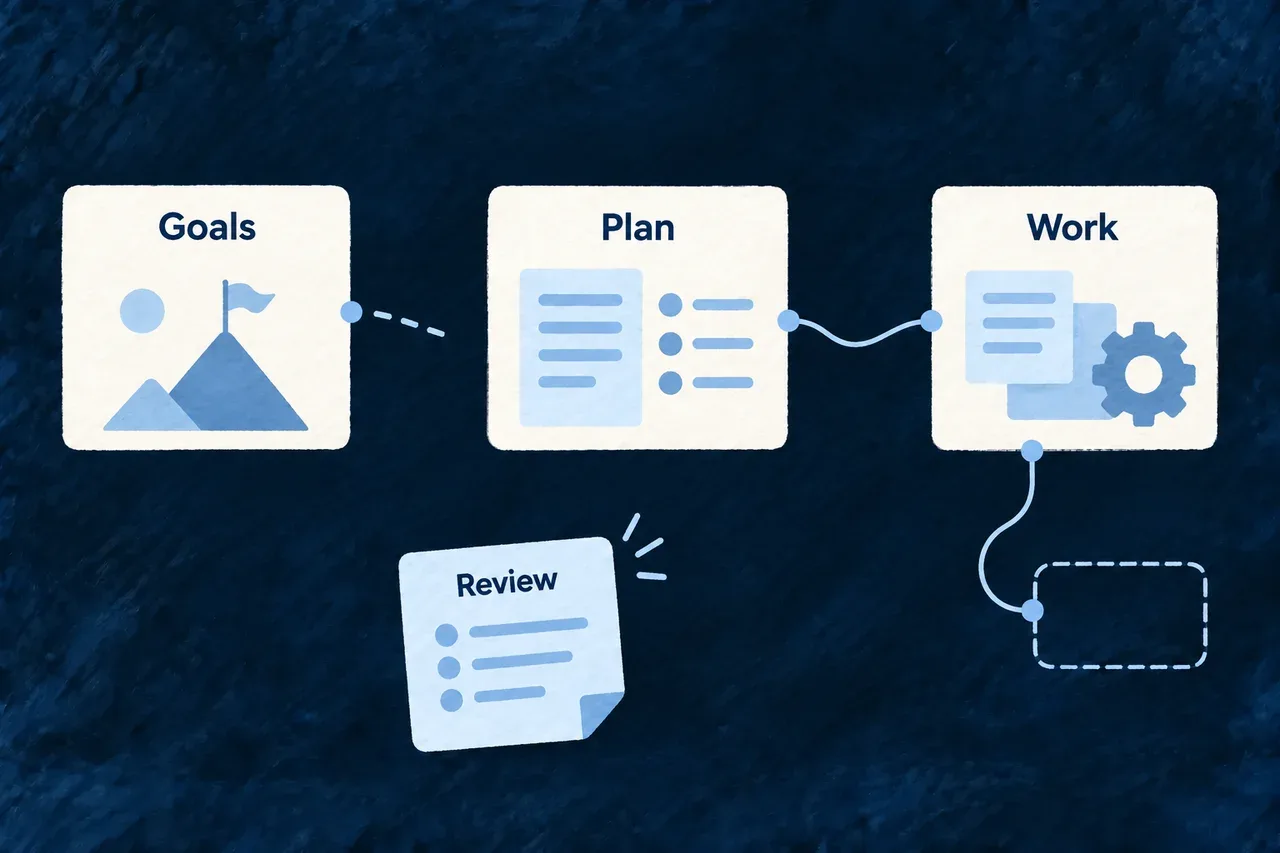
Find gaps between product decisions
A requirement can be valid on its own while referring to a customer group that no longer exists. A delivery plan can look complete while leaving a stated goal without work behind it.
Wildo compares connected product definitions and separates broken references from gaps in coverage. That distinction helps a team repair inconsistent decisions while consciously retaining work that belongs beyond the current scope.
Example — Notice a goal left out of the plan
The vision promises simpler onboarding, but no roadmap phase delivers that goal. The report exposes the gap. If a phase instead names a deleted requirement, it reports a broken reference that needs correction.
For engineers
Read the current application’s report
Run the command from an application scope with its development companion available:
wildo context health
wildo context coherence
The CLI requests /api/companion/playbooks/coherence and prints the companion’s Markdown report. The source header identifies the companion and the working-tree/export basis, which matters when comparing a report with an edit that has not reached compiled exports yet.
Interpret findings before acting
| Report information | What it tells you |
|---|---|
| Coverage finding | A declared goal or requirement lacks a supported downstream connection; deliberate deferral can explain it |
| Dangling finding | A reference cannot resolve against the available related definition |
| Families read | Which valid families contributed to this computation |
| Families absent | Which missing inputs caused dependent questions to be skipped |
| Families unreadable | Which present inputs failed their schema and could not contribute |
An empty findings list is meaningful together with the input lists. It is not evidence that every possible product relationship was checked.
See a concrete cross-family check
This source excerpt compares roadmap requirement references with declared requirements:
if (roadmap && requirements) {
  const dangling = difference([...roadmapDeliveredRequirements], requirementRefSet);
  if (dangling.length > 0) {
    findings.push({
      ref: "roadmap-delivers-unknown-requirement",
      kind: ApplicationCoherenceFindingKind.DANGLING,
      summary: `${dangling.length} roadmap phase reference(s) to a requirement that does not exist.`,
      refs: dangling,
    });
  }
}
The semantic authority supplies the family universe and schemas. The coherence owner explicitly partitions supported families into those with checks and those with a documented reason for exclusion. Adding a family therefore requires a deliberate coverage decision, rather than a second forgotten inclusion list.
Connect the report to production and review
The companion serves the report for interactive inspection; methods can request coherence context when preparing work. Generation also checks a candidate against landed related artifacts and can reject new dangling references. That candidate check and the advisory report are different consumers of the same relationships.
For governed documents, reference and section coverage establishes declared connections. It does not establish that the writing adequately satisfies a legal obligation. Review substantive meaning with the relevant evidence as well as inspecting the report.