
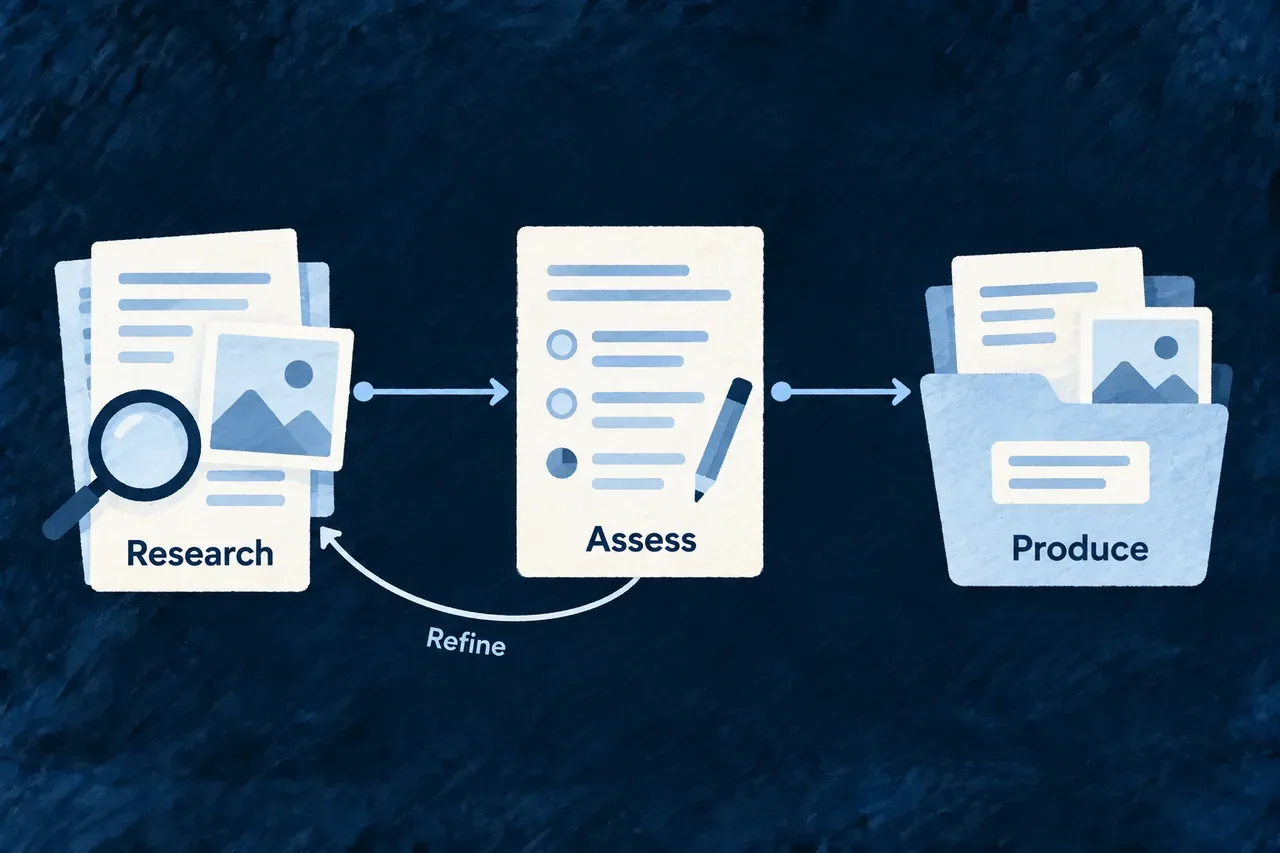
Let complex work adapt as it progresses
Some work needs a conversation between activities: gather evidence, assess it and produce a result when there is enough to proceed. A weak assessment should lead to more focused research.
A composite playbook brings those methods together. Each child declares what it needs; Wildo reevaluates the available work as results arrive, allowing the process to respond to what it learns.
Example — Research again where the evidence is thin
A market assessment finds enough information about competitors but too little about buyers. The choreography can commission another focused research pass before asking for a market snapshot.
For engineers
Admit children without prescribing a sequence
This selected configuration comes from the market-analysis umbrella:
outputs: [],
method: {
  choreography: {
    admits: [
      'top_down.market-snapshot-produce',
      'top_down.market-research',
      'top_down.market-evidence-adequacy',
    ],
    maximumIterations: 10,
    maximumLanesPerIteration: 3,
    maximumDurationMs: 2_400_000,
  },
},
The producer appears first intentionally: admits is membership, not execution order. The parent declares no artifact output of its own. Its children land the result, and write-scope admission includes their outputs when considering concurrent work.
Gate production on the result of the check
The producer’s selected precondition requires a specific verdict:
{
  kind: MetaWorkflow_PredicateKind.STEP_AVAILABLE,
  ref: 'evidence-adequacy',
  requires: { path: 'verdict', equals: 'adequate' },
},
A check having run is insufficient: its schema-validated return must contain the required value. When new research arrives, the runtime removes verdicts that depend on it, including indirect dependencies. Production becomes eligible again after reassessment returns the required verdict. A round also separates a step writer from siblings that need its result, so a producer cannot race new research using an older assessment.
Research and adequacy results are stepOutputs in the run’s context; they remain separate from persisted specification families.
Understand repetition and completion
The runtime reads artifact state together with current step results each iteration. A child that lands an artifact enters the delivered set and is removed from subsequent selection. A child returning only a step result can run again, which supports another research or assessment pass.
Research contributions accumulate as attributed text under their shared step reference, preserving earlier sources across parallel and later rounds. Structured assessment results replace their previous verdict. The selector, assessor and producer receive the retained evidence.
Successful siblings retain their results when another child fails. Checkpoints preserve the completed iteration count and returned work used by a resumed run. Iteration, duration and lane ceilings bound the attempt; a stop reason identifies whether work exhausted its options, chose to stop, reached a ceiling or saw every child in a round fail.
Those outcomes describe execution, not a blanket quality approval. An adequacy result and a landed artifact answer different questions and should remain visible separately.