
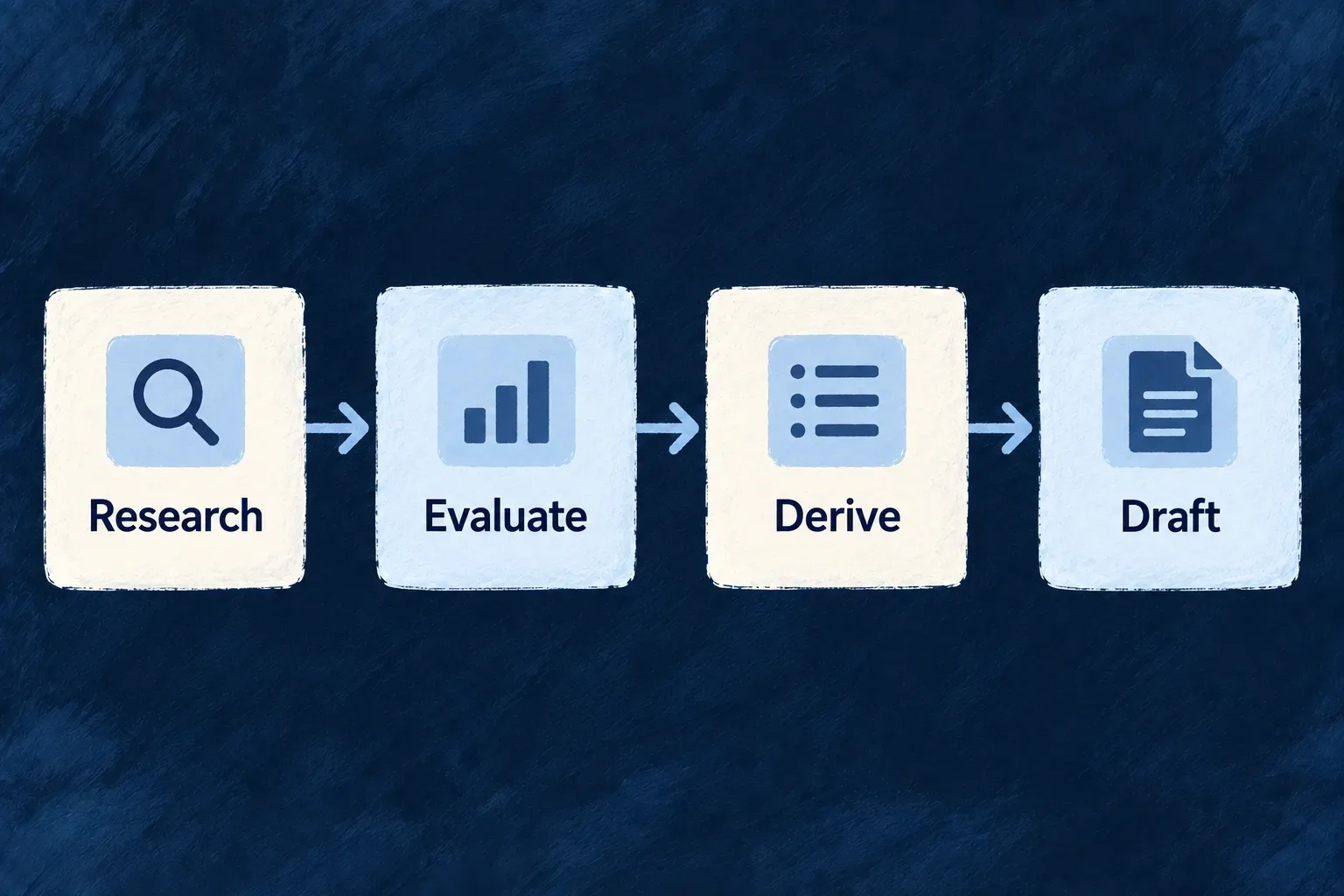
Build assurance into the work of creating the application
Assurance work belongs alongside product decisions and implementation. Wildo’s playbooks connect research and evaluation to the application’s facts, then use those facts to prepare governed documents.
Each step has a specific job and output. Research supplies material; evaluation decides whether it is sufficient; fact derivation reads the product; drafting turns declared facts into an explanation.
Example — Prepare a notice from the product’s own declarations
The fact step reads resource and operator declarations. The document step receives those facts and the document blueprint. It can improve the explanation without inventing a retention rule or deciding a legal question.
For engineers
Derive facts before drafting clauses
The actual refinement.document-facts playbook requests these context sources and declares its own execution policy:
method: {
  contextSources: [MetaWorkflow_ContextSource.COMPLIANCE_PRIMARY_FACTS, MetaWorkflow_ContextSource.DOCUMENT_FACT_OBLIGATIONS],
  skillRefs: ['journey-status'],
},
executor: MetaWorkflow_Executor.COMPANION_AGENT,
approval: MetaWorkflow_ApprovalPolicy.APPROVE_RESULT,
budget: { maxRuns: 3 },
onFailure: MetaWorkflow_FailurePolicy.KEEP_AND_FLAG,
Its output is the document-facts specification family. Vision and requirements explain purpose; resource declarations supply mechanism facts. The companion assembles those inputs and the fact schema constrains the proposed artifact.
Keep the document writer on declared facts
refinement.compliance-document-candidate receives document-facts and requests document_blueprint. Its brief-adequacy mechanism explicitly excludes raw compliance_primary_facts: those belong to the preceding derivation stage. Otherwise the writer could cite behavior that never became a declared document fact.
Let research and evaluation answer different questions
top_down.compliance-research gathers source material. top_down.compliance-evidence-adequacy returns a verdict and specific missing information for the posture stage; it does not author a document. This makes a further research round targeted rather than a repeat of the same broad request.
The intended workflow prioritizes derivation from code, configuration and evidence, using judgment for interpretation and declared operator choices where necessary. Playbook availability defines the work that can be orchestrated; it does not establish that a particular application has completed the programme or undergone assessment.