
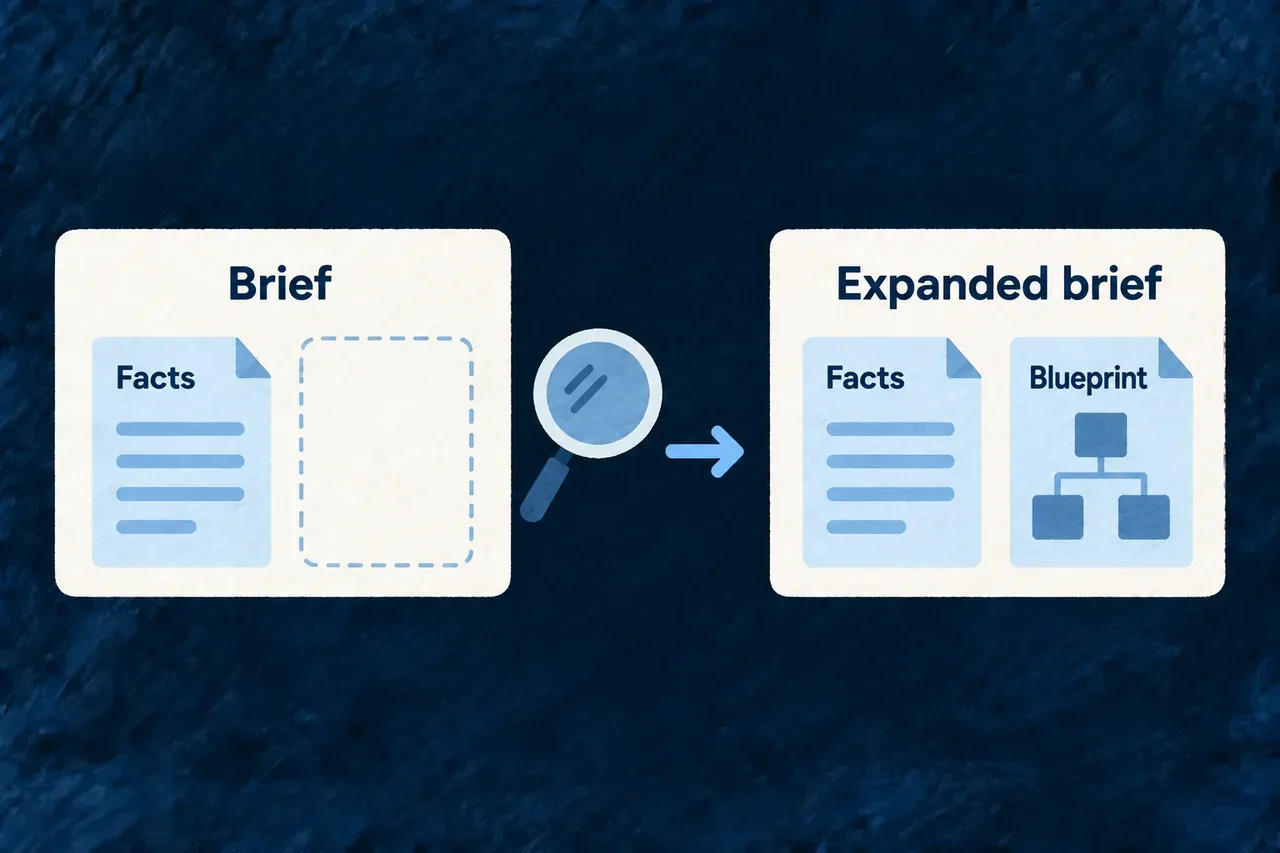
Check whether a generation brief needs more context
A generation step can receive a well-formed brief that leaves out information it needs. Wildo offers an optional check that looks for missing context before the step produces its artifact.
When an available source can address the gap, the brief is expanded for that run. Existing requirements remain in place, and the playbook controls which sources may never be added.
Example — Give a document draft its blueprint
A document-writing step needs both accepted application facts and the blueprint describing the document’s required content. A context check can identify the absent blueprint and request it before generation, without replacing the facts the draft must rely on.
For engineers
Enable the check on the method that needs it
The existing refinement.compliance-document-candidate playbook contains this method excerpt. This is selected configuration from the framework catalogue, not a complete standalone playbook:
{
  "contextSources": ["document_blueprint"],
  "briefAdequacyGate": true,
  "briefAdequacyExcludedSources": ["compliance_primary_facts"],
  "skillRefs": ["compliance-document-authoring"]
}
briefAdequacyGate defaults to false. The source exclusion preserves an intentional information boundary: this document drafter works from accepted document facts rather than interpreting raw resource mechanisms as new statements about the application.
Follow one check and one recomposition
The companion composes the generation outputs, then asks the brief-adequacy judge about the first output’s brief. The judge receives the brief and a menu of undeclared, non-excluded context sources. Its structured response names a verdict and proposed missing sources.
This selected runtime excerpt shows the add-only update:
const declared = new Set(playbook.method?.contextSources ?? []);
const excludedSources = new Set(playbook.method?.briefAdequacyExcludedSources ?? []);
const addedSources = judged.missingSources.filter((source) => !declared.has(source) && !excludedSources.has(source));
if (judged.verdict === BriefAdequacyVerdict.INSUFFICIENT && addedSources.length > 0) {
  const widened = {
    ...playbook,
    method: { ...playbook.method, contextSources: [...declared, ...addedSources] },
  } as typeof playbook;
  outputs = await composeGenerationOutputs(widened);
}
The effective declaration is a union for this run. The stored playbook is not rewritten, declared sources are not removed, and the same composers build the expanded outputs. There is no recursive planner loop.
Read the verdict for what it establishes
| Result | Runtime behavior |
|---|---|
| Sufficient | Uses the authored brief |
| Insufficient with admissible additions | Recomposes once with those sources included |
| No useful additions | Keeps the existing brief |
| Judge unavailable or invalid response | Continues with the static brief |
The companion logs the verdict and added sources, including an unavailable result. This is advisory assistance for input quality, not an artifact acceptance gate: the artifact still needs its own validation and review.
The mechanism selects from the declared context-source vocabulary. It does not invent new input families, browse arbitrary sources, or automatically plan context for every coding task. Coding dispatch separately supplies task-specific initial context and a live-query door for the agent to use.