
Cross the chasm


From Vibe Coded
applications to Professional
applications
Why Wildo, in one film
Read the film instead
A prompt field on dark blue types: "Build me a CRM for my sales team." An app assembles in seconds — Contacts, three figures and a Pipeline chart — with a badge: "Ready in minutes."
"Building an app has never been this easy."
"Then a real customer shows up." A message arrives from Acme Corp, IT Security · Procurement: "Before we sign, a few requirements…"
The requirements slam onto the screen one after another, faster and faster, until the app is buried under them: Authentication (Passwords · magic links · MFA). Authorization (Roles · fails closed). SAML & OIDC SSO (Enterprise single sign-on). Multi-tenancy (Organizations · isolation). SCIM provisioning. Audit trail → SIEM. GDPR (Export · erasure · retention). Compliance evidence. Billing (Subscriptions · invoices). i18n. Design system. Security. Observability. Email & files. Then Password reset, Invitations, Sessions, Rate limits, API keys, OAuth, Webhooks, Social login, Tenant isolation, Data export, Erasure, Retention, Invoices, Translations, Theming, Tracing, Health checks, Deployment, Transactional email, File permissions, Consent, MCP · A2A.
The last and largest: "Coherence. Every part agreeing with every other." Then a cut to black.
"None of it shows in the demo." "All of it is required before the first real user."
The chasm from the top of this page, without its bridge: "From Vibe coded applications" on the left cliff, "to Professional applications" on the right. "This is the chasm." The requirements tip off the left edge and fall into the dark.
A spark runs across the gap and the bridge appears behind it. The Wildo.ai mark rises above it: "Wildo carries you across."
The camera dives into the bridge, which becomes an engine of connected modules: Identity & MFA, Roles & permissions, SAML · OIDC SSO, SCIM provisioning, Organizations, Audit trail & SIEM, Data export & erasure, Retention policies, Compliance evidence, Billing & subscriptions, Internationalization, Design system, Fail-closed security, Observability, Email & files, AI · MCP · A2A. "The hard parts, already built. Connected in one engine."
The engine settles into a foundation and the same CRM lands on top of it, now with SSO, EN · FR · DE, an Audit log and Roles, while agents carry work up from the engine: "Your AI agents build your product on top of it."
The painted chasm again, its bridge in place, where the film stops: "Cross the chasm. Professional applications, built with AI coding agents." wildo.ai
A new kind of framework. For a new era of application building.
A software factory for AI agents. Built for corporate-grade B2B SaaS and internal tools.
You direct the product.
AI agents do the building.
They build on the capabilities already provided by Wildo, then write the rules, workflows and screens specific to your business.
- Deep engineering. Built in.
- Identity, permissions, data, billing and integrations, connected in one engine.
- Agents with a method.
- Your specifications describe what to build. Playbooks guide the steps, while project knowledge helps agents choose what to reuse, change and test.
- A whole product. Beyond the app.
- The website, documentation, administration tools and background services. Built around the same product.

A powerful engine. A product that stays yours.
Identity, business data, billing, AI and integrations. The engineering behind complex B2B applications, built to work together.
Shared rules. Fewer places to change.
Build around your business objects, operations and access rules. Wildo connects them to backend services, APIs and interfaces, with shared mechanisms for subscriptions, files, communications and AI. Add the business logic and custom screens that make the product yours.
- Define a rule. Reuse it.
- The same field definition can guide a form and validate an API request, reducing separate rules to maintain.
- Depth beyond the first screen.
- Customer workspaces, permissions, subscriptions, usage allowances and audit history support the business operations you build.
- Connect services and agents.
- Configure providers and OAuth-connected accounts. Expose business operations through MCP and conversational agents through A2A.

Your application. An environment built to run it.
Configure the databases, file storage and background services your application needs to run.
Choose where it runs. Configure it together.
Choose the services your application needs and where to host them. Wildo prepares their connection settings and deployment files, so you can configure the application and its supporting services together.
- Develop locally. Prepare for hosting.
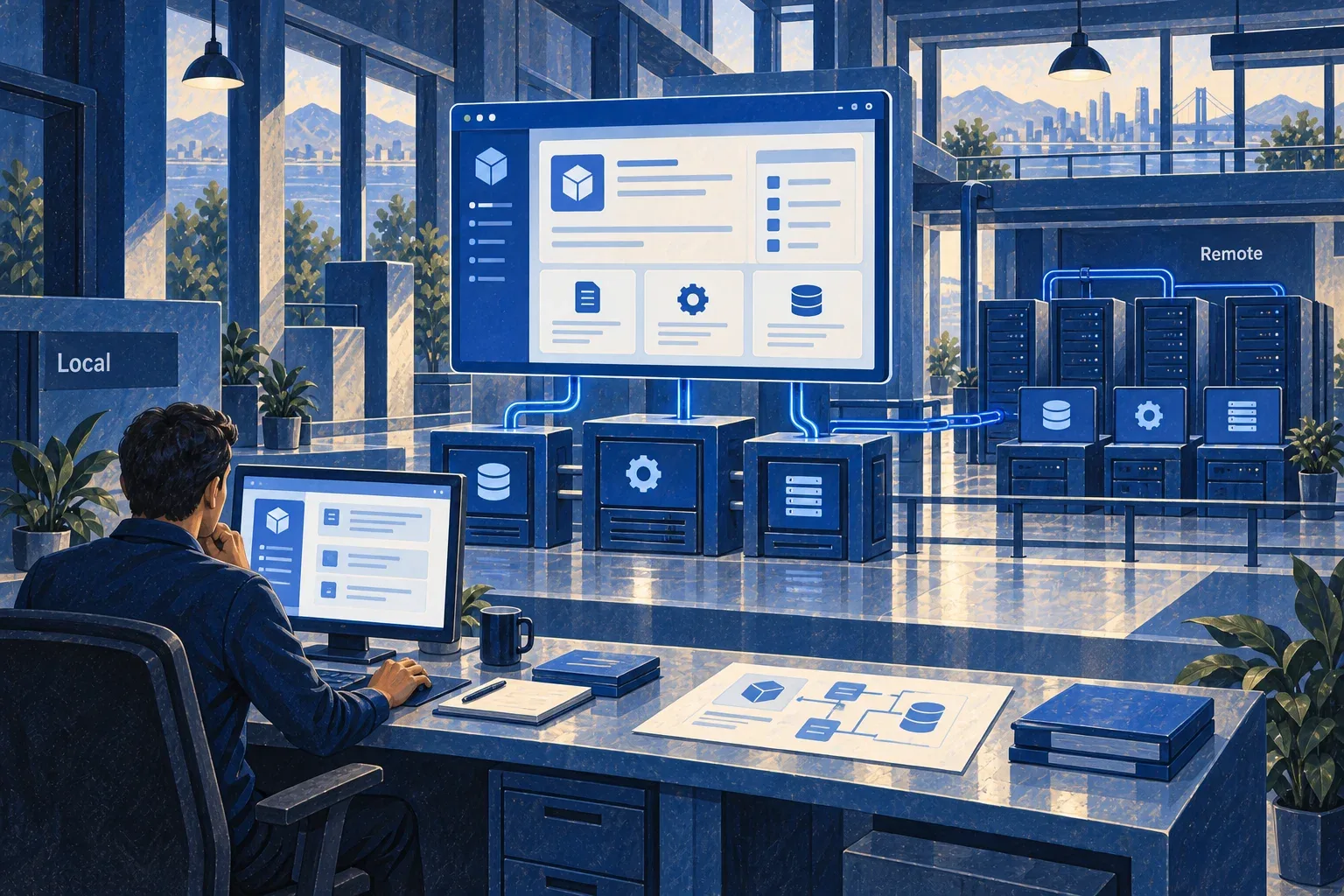
- Use services on your machine or connect remote ones. Generate deployment files for Docker Compose or Kubernetes.
- Keep background work moving.
- Add dedicated workers for specialized processing. Queue application operations and schedule recurring business tasks.
- See what needs attention.
- Check whether services are ready, read logs and follow requests across services to investigate a problem.
Deliver the product. With everything around it.
Deliver the frontend, backend API and application services, alongside the website, documentation and administration tools.
Serve your customers. Equip the people behind the product.
Your product brings together the interface people use, the backend running its business operations and the services doing specialized work. Wildo provides the application structure and shared business model, with the website, documentation and administration tools around them.
- A product people can use.
- Build software for your customers or your own teams, with the screens, permissions and workflows they need.
- A product people can understand.
- Explain your offer on the website. Help users get started and developers connect their systems through documentation.
- A product your team can operate.
- Build administration tools, add background processes and prepare the files needed to deploy the application.

Give AI the knowledge. Give the work a method.
Help coding agents understand your product, use the framework and follow the steps needed to build it.
Every change builds on the work already done.
An agent needs to know what you want, how the application works and what has already been decided. Wildo helps it retrieve that information and follow a playbook for the task, from implementation through verification.
- Keep requirements close to the code.
- Record what the product should do and why, alongside its code, so agents can refer to those decisions when making changes.
- Give agents the information they need.
- The companion helps agents inspect the application. Framework guides explain which capabilities to use and how to configure them.
- Build, check and move forward.
- Playbooks describe the steps to follow and the checks to run. You can review what changed, what was checked and what needs attention next.

Building a B2B product or an internal tool?
Wildo is not self-service yet. Tell us what you have in mind and we will say plainly whether it fits, and what happens next.